 |
|
You are here: Foswiki>Cosmo Web>CosmoTeaching>CosmoTeaching20252026>Wzat3 (08 Jun 2026, BoudRoukema)Edit Attach
Cosmic topology course
- official usosweb page 0800-WZAT-3
- EXAM: Wed 17 June | Mon 22 June | Tue 30 June 2026 10:00-16:00 @Institute of Astronomy, Piwnice, Room 48; 6 hours = maximum time; a good student can finish in 2 hours
communication
Email.what
abstract
- The aim of this course is that the students will gain an elementary intuitive and formal background to understanding the present state of astronomical research about the shape of the Universe, i.e. both the curvature and topology, but especially the topology. The course will include observational strategies. General relativity and the details of modern observational cosmology will only be presented very briefly; students who are interested will need to develop deeper understanding through their own reading and other courses.
more details
- szkic monographu dla systemu ECTS - MonographCosmoOpisShapeUniverse
- prezentacja pdf - Cosmic_topology.pdf (archive of older 20240417 version)
- short version (cosmic topology only): Roukema20240423KNSA.pdf (archive)
- also cosmic topology + topological acceleration pdf or video on PeerTube, 3 Feb 2022, Hobart
- FLRWEquationsGR - maxima
- WikipediaPl:Kosmologia_obserwacyjna
- WikipediaPl:Kształt_Wszechświata
- WikipediaPl:Współrzędne_współporuszające_się -> odległości kosmologiczne
- WikipediaPl:Inflacja_kosmologiczna
- topologia Wszechświata:
- krótki podsumowanie: Roukema 2000: AstroPh:0010185
- głeboki: Luminet & Roukema 1999: AstroPh:9901364, Lachieze-Rey & Luminet 1995: GrQc:9605010
- topologia i dynamika: AstroPh:0602159 + ArXiv:0902.3402 or ArXiv:0905.2543
- topologia i ciemna energia: ArXiv:0904.0975
- obserwacji - ArXiv:0807.4260 i artykuły tam zacytowany
- software: http://cosmo.torun.pl/GPLdownload/dodec/
- beyond the standard model: assume that the Einstein equations are correct: http://cosmo.torun.pl/~boud/inhomog110406.pdf
shape of the Universe
- http://la.wikisource.org/wiki/De_revolutionibus_orbium_coelestium/02 "Rem quoque præcipuam, hoc est mundi formam, ас partium eius certam symmetriam non potuerunt invenire, vel ex illis colligere."
- Copernicus believed that the symmetries and the shape of the Universe are the principal thing.
- history of the term shape of the Universe: HistoryOfTheTermShapeOfTheUniverse
summary of modern cosmology
- AstroPh:0602280 - George Ellis - Issues in the Philosophy of Cosmology - this is a proper scientific approach, i.e. serious philosophy explained in simple (scientific) words
- GrQc:9812046 - George Ellis - relativistic cosmology - standard + beyond standard 1998 Cargese notes
online intros to cosmology
wims - wersja online
- https://cosmo.torun.pl/wims -> students' area
- Dlaczego coś jak wims? http://wims.unice.fr/paper/pqt.pdf - a paper explaining the principle of tests with open-question sets. WIMS can be used to implement this principle.
- WimsDyskusja
- to protect against LLM scrapers (see FAQonLLMs for other ethical, cognitive, and political problems with LLMs), an initial username + password to read the web pages may be needed; ask privately for these
traditional exercises
- John Peacock has some nice online cosmology exercises: http://www.roe.ac.uk/~jap/teaching/cos5.html
intuition building
- http://www.geom.uiuc.edu/video/sos/
- geomview can be installed in any typical GNU/Linux distribution (e.g. sudo aptitude install geomview )
how
- cosmdist C library or f77 library or command line tool: https://codeberg.org/boud/cosmdist
- ./configure && make && make install
who
- się dodaj do listy, np
Main.PiotrNowak - BoudRoukema (lecturer)
exam
- exam proposal: the consensus negotiated during lectures was that the exam will be with WIMS:
- scroll up to wims - wersja online
the exam itself
-
Final date for lecturer to add new questions to WIMS: Fri 8 May 2026 - calibration: lecturer should be able to do full exam in 60 minutes with a score of at least 4.5 (out of 5)
- fixed day/time, expected up to 2 hours, allowed up to 5 hours, in the Radioastronomy building as in a traditional exam; repeat exam possible in September as in official program
- exam uses a selection of wims exercises made available in exercise mode, i.e. the questions are different but statistically drawn from the same distribution in a multi-dimensional parameter space with N >> 1 parameters
- same as for exercises: score rounded to nearest number in the set {0, 2, 3, 3.5, 4, 4.5, 5}
- physics/astro/maths constants: exact: metre-to-second conversion (p129) 1 s = 299792458 m; 1 AU = 149597870700 m; approximate: π
 3.14159265359
- The examination for this subject requires verification that the students are working through examination questions using verifiable tools. Purely online methods of verifying the students' knowledge are insufficient for this course, so a face-to-face "traditional" exam is required. Experience has shown that some students use scientifically invalid methods.
temporary isolated machine
Starting in 2025, the exam will be conducted on a individual computer for each student; the computer will run on a Debian GNU/Linux operating system with no internet connection. This computer will run a (purely local) WIMS server with the statistically same set of exercises as you have available during the semester.- differences wrt exercises
- stronger prerequisite relation between exercises - you must do the easier exercises before being allowed to try the harder ones
- more severe scoring system:
 instead of
- no internet acccess
- no access to hand calculators, mobile phones, laptops, or other private computers (mobile phone use OK if you are taking a break away from your screen)
- fresh shell account - no access to personal notes or scripts; the lecture pdfs will be available in your account
- you will have the usual FOSS tools: emacs, vim, bash, less, grep, awk, sed, octave, python, numpy, scipy, maxima, gcc, gfortran
- you will have these files in your guest shell account with md5sums:
- 47e54ad34928b502b86046f3fda15ddf cosmdist-0.3.12-3ea40c1.tar.gz
- 757b6cef51acfbd24e5b8d6fcfd2a0c7 Cosmology_30h_lecture.pdf
- 200b400f0704b6dfb04fef366f98f266 gr_140407.pdf
- 15b0cb0a9dbc4508277f5513a94290e6 sr_240412.pdf
- 286829f6921ea62e18327fcd428e5d00 Cosmic_topology.pdf
- 5a053da1fed410dda159fe7c7a077f72 SI_math_constants
- physics/astro/maths constants: exact: metre-to-second conversion (p129) 1 s = 299792458 m; 1 AU = 149597870700 m; approximate: π 3.14159265359 - these are given in the file
SI_math_constants - cheap powerful technology: you may bring in blank paper and some pens/pencils
- you will need to "register" a new (temporary) account in the WIMS class
- you will need to show the examiner the "My Score" page when you are satisfied with your grade and ready to have your score written to usosweb.
$ dpkg -l |awk '{print $1,$2,$3}' |grep -E " (octave|maxima|python3(|-numpy|-scipy)|emacs|vim-tiny|xpdf|evince|gcc|gfortran) "
ii emacs 1:28.2+1-15+deb12u4
ii evince 43.1-2+b1
ii gcc 4:12.2.0-3
ii gfortran 4:12.2.0-3
ii maxima 5.46.0-11
ii octave 7.3.0-2
ii python3 3.11.2-1+b1
ii python3-numpy 1:1.24.2-1+deb12u1
ii python3-scipy 1.10.1-2
ii vim-tiny 2:9.0.1378-2+deb12u2
ii xpdf 3.04+git20220601-1+b2
exercise mode (24/7)
- exercise mode:
- Scoring is enabled by default - but this does not count for any official zaliczenie!
- Scoring is not limited by IP range - you can practice from Spain or Fiji if you wish.
- anti-LLM-scraper protection (see FAQonLLMs) - ask offline if access to the page https://cosmo.torun.pl/wims is blocked for you
- link to wims: https://cosmo.torun.pl/wims - the exercise mode sheets have a warning in Polish ,,(bez zaliczenia!)" to remind you that your scores in exercise mode do not count officially
- Choose Students' area in the left-hand column of the WIMS interface.
- Create an account for this particular class - this account is only for this particular class, and only for the exercise mode
5.0 grade points on WIMS - how it's calculated
- You can get a grade of up to a maximum of 5.0 points from WIMS exercises:
-
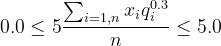 where
where -
 is the percentage done for a given "sheet" - let us normalise this to the range from 0.0 i 1.0
-
 is the "quality" - in the range from 0.0 to 1.0; the power of 0.3 implies that the effect of is weak unless the "quality" parameter is very low
-
- how to check your current score:
- home
- My scores
- Global average: something out of 5. Here, something is your total amount of points
- My scores
- home
-
- The formula for a single exercise done m times, is
 po m razy, gdzie
  , which is in the range from 0.0 to 1.0. This is a decaying average, with
 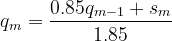 . In other words, the most recent tries at a realisation of an exercise have the most influence on the score for that exercise.
- Chromium/Chrome bug: As of 2020 to 2024, chromium/chrome browser software has a bug that prevents the display of some of the exercises. Firefox is one browser without the bug. In any case, Chrome is like a two-way mirror with little chance of protecting your privacy (despite EU regulations).
Edit | Attach | Print version | History: r3 < r2 < r1 | Backlinks | View wiki text | More topic actions
Topic revision: r3 - 08 Jun 2026, BoudRoukema


 Cosmo
Cosmo Copyright © by the contributing authors. All material on this collaboration platform is the property of the contributing authors.
 Ideas, requests, problems regarding Foswiki? Send feedback